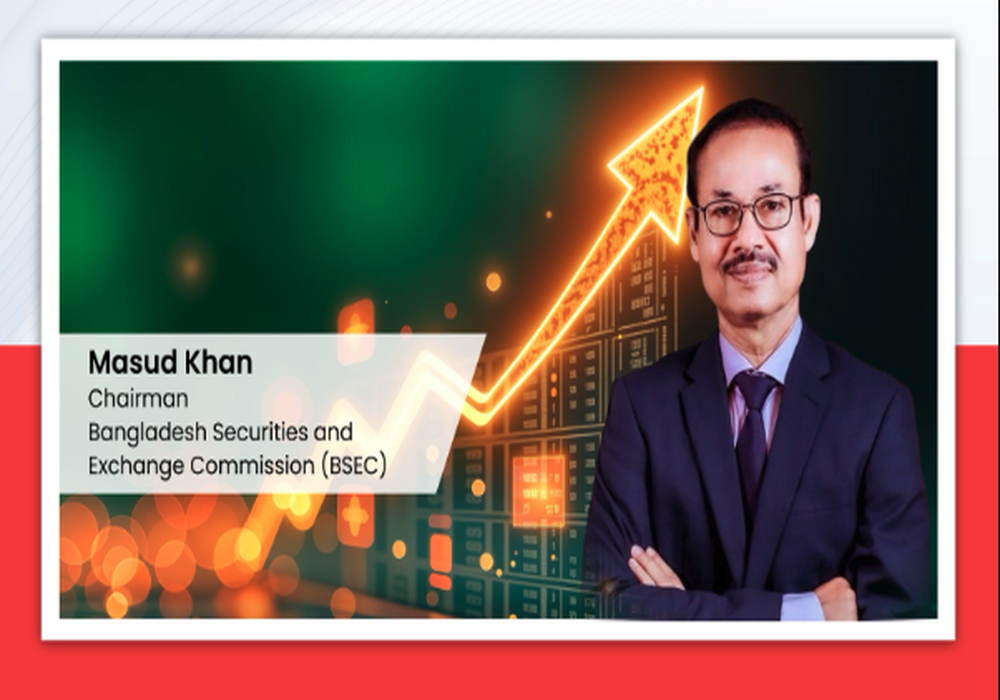
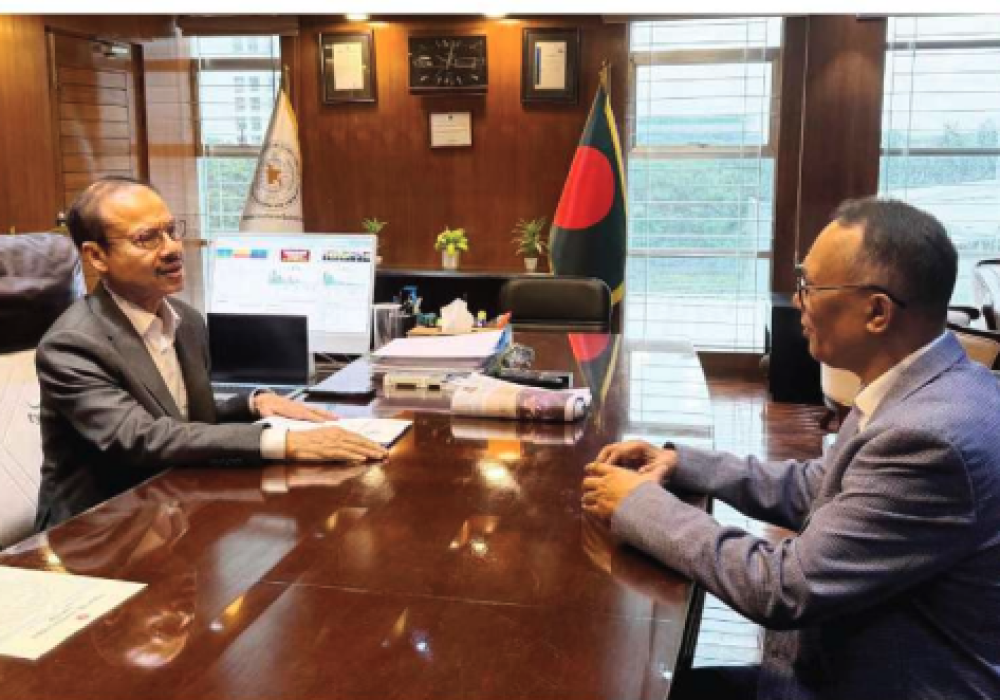
Bangladesh's capital market is entering a pivotal phase of recovery and reform, and Mr. Masud Khan, Chairman of the Bangladesh Securities and Exchange Commission, is steering this transformation. In this special interview for the Foreign Investors' Chamber of Commerce and Industry's publication, he reflects on the Commission's efforts to restore investor confidence, deepen institutional participation, and modernize market infrastructure.
From removing distortions such as floor-price restrictions and enabling faster settlement cycles to introducing digital reporting, Al enabled surveillance, and direct listing reforms, Khan underscores that the goal is not to engineer a market that never declines, but to build one that is fair, resilient, and globally credible. His vision is clear: a capital market anchored in transparency, enforcement, and innovation, capable of attracting long-term domestic and foreign institutional capital while positioning Bangladesh as a compelling destination among emerging economies.
Q1 Current state of the market
How would you assess the current state of Bangladesh's capital market, particularly in terms of investor confidence, market depth and overall market development?
Bangladesh's capital market is in a recovery and rebuilding phase. Confidence has improved from the very weak levels seen earlier, but it remains fragile because investors have experienced repeated policy interventions, governance failures, weak disclosures and episodes of manipulation. The deeper concern is structural. The market remains heavily dependent on retail investors, while participation by pension and provident funds, insurers, mutual funds and other long-term institutions is limited. The equity market also lacks an adequate pipeline of large, well-governed companies, and the corporate bond market remains shallow.
Consequently, liquidity and research coverage are concentrated in a relatively small number of securities. My is assessment is therefore cautiously positive. The direction has improved, and the reform programme gaining momentum, but sustainable confidence must be earned through consistent rules, credible enforcement, better-quality listings, reliable financial reporting and fair treatment of every investor. Our objective is not to create a market that never falls; it is to build a fair and resilient market that can discover prices and recover through its own strength.
Q2 BSEC's recent initiatives
Since the change in government, what have been the key initiatives undertaken by BSEC to address the longstanding challenges facing Bangladesh's capital market?
Since the new Commission assumed office in June 2026, our first priority has been to remove distortions, modernise the market infrastructure and restore institutional credibility. The remaining floor-price restrictions were withdrawn on the Commission's second day. This restored normal price discovery and removed a long-standing impediment to foreign-investor confidence and Bangladesh's standing with international index.providers. BSEC has also taken the initiative to facilitate the repatriation of dividends by multinational companies after obtaining the necessary approval from the National Board of Revenue underthe applicable double taxation agreements. We revised the margin framework within a short period, moving towards principles-based risk management rather than overly rigid limits. BSEC has approved intraday trading, while the DSE and relevant institutions are preparing for T+1 settlement.
We have also restored greater frontline authorityto the stock exchanges, including the ability to investigate suspicious transactions, conduct physical inspections and determine appropriate market-control measures within the regulatory framework. A risk-based inspection programme has been developed for brokers and intermediaries. Technology is another central pillar. BSEC and DSE systems are being upgraded, with digital order authorisation, instant investor notifications, stronger back-office controls and Al-enabled surveillance planned to detect unusual trading patterns more quickly. The digitisation programme will also introduce XBRL-based financial reporting by listed companies and other issuers, enabling financial information to be submitted in a standardised, machine-readable and readily comparable format.
Routine regulatory reporting by market intermediaries and other regulated entities, including brokers, merchant banks, investment banks, mutual funds and asset management companies, will likewise move to structured digital formats. This will reduce manual submissions and duplication, improve data quality, facilitate automated validation and risk-based supervision, and allow BSEC to identify reporting anomalies and emerging risks more quickly. Media reporting has highlighted these measures as part of a wider shift towards faster settlement, less paper-based processing and more responsive supervision. We have also acted to broaden the supply of quality securities. Draft direct-listing rules have been prepared to facilitate the entry of sound companies, and more market-friendly IPO rules, including scope for hybrid offerings that combine fresh capital with sponsor sell-down, are under preparation.
Work is progressing on the Central Counterparty Bangladesh Limited, commodity-exchange implementation, and a deeper bond market. In the mutual-fund sector, dividend-distribution requirements and custodial processes have been rationalised. The consolidation of the principal securities laws has been completed and sent to the relevant ministries, and the Capital Market Stabilisation Act is at an advanced stage. Where a specific threat to investors or market reputation arose, the Commission acted pragmatically. For example, BSEC facilitated the board process needed to avert the imminent delisting of Beximco Pharma's GDRS while the question of board composition remained before the court.
These actions reflect a consistent approach: remove unnecessary barriers, protect investors, strengthen market institutions and take action against proven misconduct. BSEC will also work closely with Bangladesh Bank, the National Board of Revenue, the Financial Institutions Division, BIDA and other relevant regulatory and government bodies through regular high-level coordination meetings, because many of the constraints facing the capital market extend beyond the jurisdiction of any single regulator.
Q3 Restoring investor confidence
What are some of the most critical reforms needed to rebuild investor confidence in Bangladesh's capital market, and how soon can investors realistically expect to see tangible improvements?
The most critical reform is predictability. Investors must know that rules will be applied consistently, that prices will be determined by market forces and that the regulator will not use short-term or artificial measures to influence the index.
Falling or rising prices do not by themselves prove manipulation. BSEC's role is to ensure a fair, transparent and orderly market, enforce securities laws, protect investors and facilitate capital formation. Confidence also requires credible enforcement. Suspicious trading, insider dealing, misuse of client assets, false financial reporting and governance failures must be detected quickly, investigated professionally and sanctioned consistently.
That is why risk-based inspections, stronger exchange-level supervision, digital audit trails and Al-assisted surveillance are important. At the issuer level, better financial reporting, auditor accountability, meaningful independent directors and timely disclosure are essential. Investors should see operational improvements in stages. Some changes are already visible, including removal of the remaining floor prices, revision of margin rules, restoration of exchange authority and approval of intraday trading.
Other measures, such as direct listing, T+1 settlement, improved surveillance, CCBL operations and broader listing reforms, require system changes, stakeholder consultation and legal procedures. Tangible progress should therefore be expected over the coming months, while the deeper restoration of trust will require consistent implementation over several years. We should be careful not to promise a particular index level or a market that never declines. The credible promise is a fairer market, stronger institutions, better-quality securities, deeper equity and bond markets, and timely action against proven misconduct.
Q4 Institutional investor participation
What policy and regulatory changes are needed to encourage greater participation by institutional investors, a trend seen in most developed as well as emerging capital markets?
Bangladesh cannot build a deep and stable capital market while depending predominantly on short-term retail flows.
We need pension funds, provident and gratuity funds, insurers, mutual funds, banks, asset managers and other professional investors to become long-term providers of capital. Their participation would improve research, valuation discipline, liquidity and corporate oversight, while reducing the market's sensitivity to rumours and short-term sentiment.
The first requirement is to remove regulatory and tax biases that favour bank deposits and government securities even where a professionally managed, diversified market allocation would be appropriate. The Government plans to amend the Trust Act so that trusts are required to invest 25 percent of their investible funds in listed shares, mutual funds and corporate bonds. This would create a stable pool of long-term institutional capital, but the requirement should be supported by appropriate diversification, governance, trustee-capacity, suitability and risk-management safeguards. Investment rules for pension, provident, gratuity and insurance funds should similarly permit prudent allocation to listed equities, corporate bonds, sukuk, mutual funds and infrastructure securities. Tax treatment should be stable and should not disadvantage collective-investment vehicles or long-term investment.
Second, the investment-management ecosystem must become more credible. Mutual funds need transparent valuation, clear fee disclosure, proper custody, independent trusteeship, stronger governance and performance reporting against appropriate benchmarks. Institutional investors should be encouraged to develop written investment policies, qualified investment teams, risk controls and stewardship responsibilities, including informed voting on material shareholder matters. Third, institutions need investible products and reliable infrastructure. This requires more large, profitable and well-governed issuers; a credible corporate-bond yield curve; market-making and securities-lending arrangements; efficient clearing and settlement; and dependable disclosure in machine-readable form. BSEC's work on direct listing, IPO reform, the bond market, CCBL, T+1 settlement and mutual-fund regulation is intended to build that foundation.
Q5 Foreign investor opportunity
Beyond regulatory reforms, what do you believe Bangladesh needs to do to differentiate itself from other emerging and frontier markets and position its capital market as a compelling destination for long-term foreign institutional capital?
Bangladesh must offer foreign investors a clear investment proposition, not merely lower valuations.
The country's strengths include a large domestic market, a young workforce, a strong manufacturing base and long-term demand for infrastructure, energy, logistics, healthcare, financial services and technology.
These strengths must be represented on the exchange through a pipeline of large, well-governed companies, including successful local groups, multinationals, state-owned enterprises and infrastructure assets.
Foreign institutions also evaluate whether they can enter, operate and exit efficiently. Bangladesh therefore needs dependable foreign-exchange access and dividend and capital repatriation; stable and comprehensible taxation; efficient account opening, custody and settlement; adequate free float and liquidity; consistent application of ownership rules; high-quality English-language disclosures; and internationally credible accounting, auditing and governance. In this regard, BSEC has taken the initiative to enable multinational companies to repatriate dividends after securing the required NBR approval under the relevant double taxation agreements. Restoring normal price discovery and pursuing faster, digital settlement are also important parts of this effort.
Differentiation will come from execution. Bangladesh should develop thematic opportunities in areas where it has a genuine economic story, such as export manufacturing, climate-resilient infrastructure, renewable energy, affordable housing, healthcare and digital services. Green, social, sustainability and infrastructure bonds can connect these needs with global long-term capital, provided proceeds and impact are independently verified. Finally, market development and promotion must be evidence-based and coordinated. BSEC will work closely with the exchanges, Bangladesh Bank, NBR, BIDA, the Financial Institutions Division and other regulatory bodies, including through regular high-level coordination meetings, to resolve cross-cutting constraints and maintain reform momentum.
Together, these institutions should present investors with a single, reliable account of the rules, investible companies, sector opportunities and reform milestones. Global investors will not commit because of a promotional campaign alone. They will commit when Bangladesh combines attractive companies with policy stability, credible institutions, liquidity, transparent data and an established record of fair treatment.