
 Admin
Admin
 April 1, 2026
 (0) Comment


Admin
April 1, 2026
(0) Comment
A. Trade-Led Growth and the Strategic Role of Ports
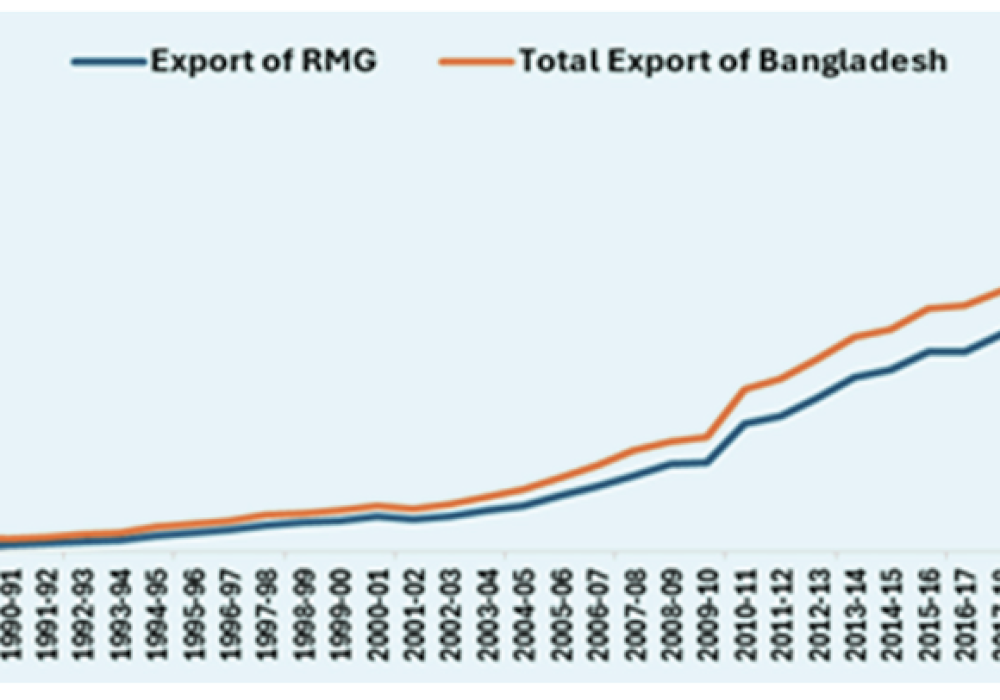
Bangladesh is entering a defining phase of its development, shaped by a new political horizon and renewed momentum for reform. With more than $450 billion economy, the country's path to stability, job creation, and sustainable growth will continue to depend heavily on trade. Over the past two decades, export-led growth, anchored largely in textiles and ready-made garments, has powered Bangladesh's rise, delivering average economic growth of over 6 percent since 2000 and lifting the country to lower-middle-income status. As Bangladesh prepares to graduate from LDC status in 2026 and pursues its ambition of becoming a high-income country by 2041, exports must expand far beyond their current scale to compete in a $33 trillion global trading system 1. Yet with a relatively small domestic market, deeper global integration is not optional. In this context, the modernization of ports, through greater efficiency, capacity, and reliability, will be a decisive factor in determining whether Bangladesh can sustain its export momentum and translate global opportunities into inclusive growth at home.
Figure 1 Sustained Growth in Bangladesh's Exports Over Time (in million USD)
B. Why Modern Ports and Logistics Matter for Efficient Trade Facilitation
Ports and logistics systems are the backbone of global trade, determining how efficiently goods move within countries and across borders. According to the World Bank, more than four-fifths of global merchandise trade by volume is transported by sea 2, while containers account for roughly 35 percent of total cargo volumes and over 60 percent of global trade value 3. This makes efficient container handling central to trade competitiveness and connectivity.Port performance, however, is inseparable from the quality of supporting infrastructure. Efficient road, rail, and inland waterway connections, strong hinterland linkages, and seamless port access significantly enhance competitiveness. Countries with well-connected port systems benefit from lower trade costs, higher transport efficiency, and a more business-friendly environment. As the pandemic underscored, port efficiency is not merely a logistics issue, it is a strategic economic asset, shaping resilience, investment decisions, and the timely delivery of essential goods.
C. Port and Logistics Inefficiencies a Key Hurdle to Competitiveness
Trade openness alone does not guarantee growth; competitiveness depends on how efficiently a country can move goods. For Bangladesh, this reality is becoming unavoidable. As labour cost advantages gradually erode, the country's next phase of export-led growth will be determined less by wages and more by the quality of its logistics and trade infrastructure. Yet progress in this area remains slow and uneven.
Despite years of strong export performance, Bangladesh's logistics ecosystem continues to lag behind peers. Congested transport networks, weak multimodal connectivity, and fragmented logistics services add substantial cost and delay to trade. This underperformance is visible in global rankings: Bangladesh stands 88th in the World Bank's Logistics Performance Index and 39th out of 50 countries in the Agility Emerging Markets Logistics Index. These numbers point to a structural constraint, exports have grown in spite of logistics inefficiencies, not because of improvements in them.
|
Table 1 Global Indices Signal Major Room for Improvement |
Ports, which globally have evolved into integrated logistics hubs, remain a critical bottleneck in Bangladesh. Efficient ports reduce trade costs, improve reliability, attract foreign investment, and support regional development. In Bangladesh, however, outdated practices, limited capacity, and poor hinterland connectivity continue to undermine these benefits. Logistics costs reach as high as 48 percent in some sectors 4, far exceeding those of competing economies. The World Bank estimates that targeted logistics reforms could increase export earnings by up to 19 percent, while even a 1% reduction in logistics costs could raise export demand by more than 7% 5, gains that Bangladesh can ill afford to ignore as it approaches LDC graduation in a more protectionist global trade environment.
Figure 2 Several Issues Require Priority Attention for Logistics Sector Development
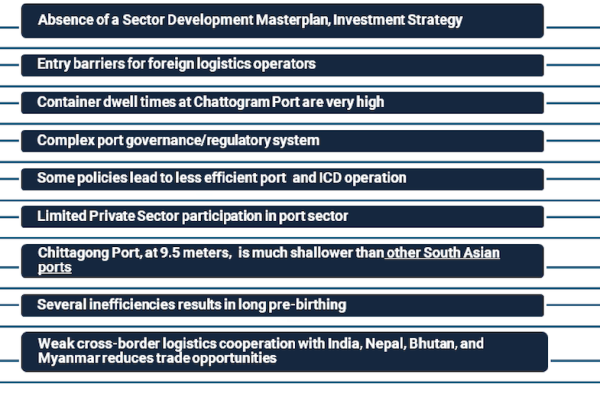
Nowhere are these weaknesses more evident than at Chattogram Port, the country's primary trade gateway, handling over 90 percent of seaborne trade and nearly all container traffic. High berth occupancy, long vessel turnaround times, and slow cargo clearance remain persistent problems. The port ranks 356th out of 403 ports globally in the Container Port Performance Index 6, with average container ship turnaround times of around 2.5 days, the shortest in six years, yet still about 12 hours longer than at Sri Lanka's ports 7, highlighting persistent efficiency gaps despite recent improvements. Import clearance takes around 11 days 8, while export border compliance remains cumbersome and time-consuming. Without decisive modernization of port operations, governance, and connectivity, Bangladesh risks allowing logistics inefficiencies, not market demand, to define the limits of its trade competitiveness.
D. Modernizing Ports and Logistics: Recent Progress
In recent years, the government has increasingly recognized that logistics inefficiencies are a binding constraint on Bangladesh's trade competitiveness, prompting a shift toward more structural reforms in the port and logistics sector. A key development has been the engagement of experienced foreign port operators through ong-term concession and public-private partnership arrangements at facilities such as Laldia and Pangaon.
These initiatives aim to introduce global operational standards, modern terminal management practices, and advanced technologies to improve productivity, reduce congestion, and enhance service reliability, signaling a gradual move away from traditional, state-dominated port operations.
Figure 3 Recent Initiatives to Improve Port and Logistics Sector
Alongside operational reforms, the government has initiated major capacity-expansion projects, including new container terminals such as the Bay Container Terminal and the Matarbari Deep Sea Port, which are expected to significantly increase container-handling capacity and improve vessel turnaround times. At the policy level, the adoption of the National Logistics Policy marks an important step toward addressing longstanding coordination gaps by promoting multimodal connectivity and integrated planning across ports, roads, railways, and inland waterways. Together with digital trade facilitation initiatives such as the National Single Window, these measures reflect a growing recognition that modern ports and efficient logistics are essential to sustaining export growth in a post-LDC, increasingly competitive global trade environment. However, their success will ultimately depend on timely implementation, regulatory clarity, and sustained institutional coordination to translate ambition into tangible performance gains.
E. What Must Happen Next
Modernizing trade infrastructure and logistics is essential not only for strengthening Bangladesh's position in exports, but also for enabling export diversification into higher-value sectors and new markets.
According to UNESCAP, improved infrastructure could generate economic gains of up to USD 35.5 billion for Bangladesh by 2030 9. Capturing this potential will require the development of an integrated logistics system anchored by world-class ports, efficient transport corridors, adequate storage facilities, and technology-driven clearance and turnaround processes.
Figure 4 Building a Logistics Ecosystem: Key Policy Priorities Recent flagship investments offer a critical opportunity to address long-standing capacity and efficiency constraints. However, the gains will materialize only if port expansion is matched by timely upgrades to road, rail, inland waterway, and warehousing infrastructure that connect ports to key commercial hubs. Ultimately, creating a competitive port and logistics ecosystem will require a whole-of-government approach, strong coordination across agencies, effective private sector participation, and sustained focus on execution, to ensure that infrastructure investments translate into real trade competitiveness.